Inside This Issue:
- An Awful Animal Rights Ballot Measure Presents a Rare Opportunity
- Happy the Elephant Dies at 55
- A Beach Starts Its Slow Goodbye to Donkey Rides
- Retail Rescue, Chernobyl's Horses, and More!
Awful Animal Rights Ballot Measure Presents a Rare Opportunity

Imagine trying to breed, or even own a pair of beautiful purebred dogs like this in an IP28 world (you can't).
Multiple sources report that Oregon Initiative Petition 28 has received enough signatures to qualify for Oregon's November ballot. "Enough" is not a done deal: once the formal submission deadline is reached on July 2nd, the signatures gathered will need to be formally verified to assure their legitimacy. Typically, about 20% of petition signatures are invalidated during this process, so we expect supporters to be working extra hard to gather another 25,000–30,000 signatures during the next month.
We understand the alarm that this extreme measure has caused. Its wording bluntly threatens critically important pursuits in animal agriculture, hunting, fishing, trapping, animal husbandry, sport, research, meat and dairy, nutrition standards, ecological and wildlife balance, game management – aspects that touch all our lives and livelihoods.
But from our vantage point, having this initiative land on the November ballot would be a gift, providing an opportunity that we – the responsible animal businesses, hobbies, scientific and conservation communities – have not had in a generation: an opportunity to tell our stories and expose the ideological monster that’s been stalking our communities for decades.
We know that people outside of Oregon think that we're crazy enough out here to pass it, but we have faith that Oregonians will recognize the extremism in IP 28 and vote against:
- criminalizing accepted dog training, handling and husbandry practices, including artificial insemination, and even hands-on assistance during the delivery of puppies.
- eliminating billions in conservation and wildlife management funding by ending hunting, fishing, trapping, and related activities in the state.
- removing the word “intentional” from the animal abuse statutes, creating criminal liability for accidental harm to an animal.
- eliminating massive coastal employment and recreation activity in commercial and recreational fishing and maritime pursuits.
- curtailing livestock, dairy and poultry operations along with regulated farming, grazing and agricultural land management.
- eliminating all scientific work that involves animals, no matter how humane, responsible or how beneficial it is to both people and animals.
The list goes on. Obviously, if IP28 manages to get on the ballot we will work around the clock to defeat it. But in the meantime (and because we believe that Oregonians would soundly defeat it if it landed on the ballot), instead of fearing IP28, we see it as providing a once-in-a-generation opportunity to educate the state, lawmakers, and media about the many ways our animal communities contribute to the quality-of-life that Oregonians enjoy.
NAIA has scheduled meetings, both video conference and in person, with organizations and clubs across the state to discuss and work on this issue. We would welcome your active input and involvement as we move forward with developing an effective communications plan. If you or your organization would like to be involved, host a video conference or be part of a work party, please contact us at naia@naiaonline.org or (503) 756-0826.
NAIA and Responsible Dog Breeders of Oregon have been your advocates since the early 1990s. We look forward to working with you again!
Source: Radical Initiative to Ban Hunting and Fishing in Oregon Is One Step Closer to Making the Ballot
Happy the Elephant Dies at 55
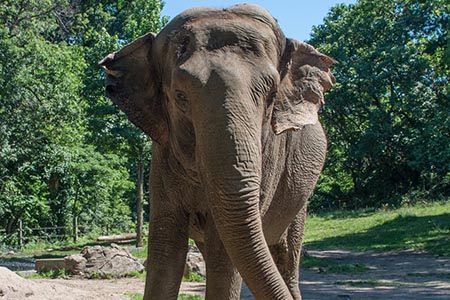
Happy the Elephant, Bronx Zoo social media post.
Happy, a 55-year-old Asian elephant who had called the Bronx Zoo home since 1977, was euthanized this week after a period of hospice care. Most likely born in Thailand, Happy (named after one of Snow White’s seven dwarfs) lived briefly in a Florida petting zoo alongside six other elephant calves, and was later acquired by the Bronx Zoo.
In 2002, the dynamics of Happy’s herd shifted in ways that would define the rest of her life. Shortly after the herd’s elder female died in 2002, two other elephants in the group, Patty and Maxine, attacked and fatally wounded another elephant. Happy could no longer be safely housed with them, and matters soon became worse after a young female that was brought in as a companion for Happy died shortly after arriving. It was a difficult set of circumstances – the kind that animal rights ideologues would seize on to paint the Bronx Zoo as negligent and even cruel.
What made Happy a legal cause was a cognitive milestone she achieved in 2005, passing a mirror self-recognition test, putting her squarely in the crosshairs of the Nonhuman Rights Project (NhRP), an organization whose central mission is to reclassify certain animals as legal persons. They took on Happy's case in 2018, arguing that the habeas corpus principle, the legal mechanism humans use to contest unlawful imprisonment, should apply to cognitively complex animals like elephants.
This is where the story gets murkier. NhRP’s broader agenda is rooted in the animal rights philosophy that views any human use of animals as a form of speciesism – an unjustifiable moral bias. And like all but the most strident animal rights ideologues, they are able to present their case in a way that has a slick surface appeal – after all, who doesn’t like the ideas of “putting an end to suffering” or the more nebulous “freedom?” But under their framework, a zoo isn't a conservation institution that people go to learn about and enjoy animals, but a prison. To people with this mindset, even the best-managed, well-resourced elephant program is still jail – and an opportunity for their lawyers to represent “unlawfully imprisoned” animals, and remove said animals to their own prisons… er, “sanctuaries.” Fortunately, New York's highest court disagreed with NhRP, rejecting the lawsuit 5-to-2 in 2022 in what was considered the first case of its kind to reach such a high court in the English-speaking world.
But the legal outcome, while correct (even if we wish it was a 7-to-0 decision), doesn't fully address the underlying misconception that fueled the lawsuit in the first place. The activists pointed to Happy's social situation, her separation from other elephants, as evidence of suffering and neglect. What they consistently failed to acknowledge is that elephant socialization in human care is genuinely complex, and there is no universal formula for it. Elephant society is matriarchal by nature, structured around dominant females whose personalities and status within the group shape every interaction. Two strong-willed, dominant females don't automatically form a peaceful bond just because they share a yard. The Bronx Zoo consulted with elephant experts in an effort to find a way to integrate Happy and Patty, and the conclusion was that their respective temperaments made cohabitation unsafe. That isn't a failure of care. Rather, it's exactly the kind of nuanced, animal-specific decision-making that professional elephant management requires. Studies of captive elephant populations worldwide have shown that poor social compatibility can actively harm individual welfare, making forced introductions potentially more damaging than managed separation.
There's also an important historical context here. Many of the older elephants currently living in North American zoos were raised and trained during an era when herd socialization wasn't as well understood or prioritized. The field has evolved considerably since then, and much of what we now know about the importance of social bonds in elephants came, in part, from cases like Happy's. That's not an indictment of the Bronx Zoo – it's a reflection of how animal care science progresses.
Happy's final years were, by all accounts, attentive ones. Her keepers were closely bonded with her, and she was able to maintain proximity to Patty through the use of bollards, a managed contact approach that allows elephants to interact safely without the risk of physical conflict. Whether or not the two were communicating during that time is, frankly, something no activist or attorney can claim to know. Elephants communicate at infrasonic frequencies well below the range of human hearing, and as research into elephant communication has shown, they also exchange information through chemical signals: hormone secretions from their temporal glands, urine, and dung. The full picture of what passes between two elephants sharing a space, even a divided one, is not something humans can easily read.
That's precisely the problem with the Nonhuman Rights Project's approach. Their case rested on the assumption that they understood Happy's inner experience well enough to declare her imprisoned and demand her relocation. But elephant welfare isn't determined by ideology or legal theory. It's determined by the people who spend years studying individual animals, learning their personalities, monitoring their health, and making hard calls when circumstances change. The Bronx Zoo's team did that work. The activists didn't and the court, correctly, recognized the difference.
Happy outlived the median life expectancy for female Asian elephants in North American zoo facilities by a full decade. Patty, now 57, remains the zoo's sole elephant. The Wildlife Conservation Society, which operates the Bronx Zoo, stopped acquiring elephants twenty years ago in favor of directing resources toward wild populations. Whatever one thinks of that decision, it's not the posture of an institution indifferent to elephant welfare.
Happy's story will keep being told. The Nonhuman Rights Project will keep citing her case as a stepping stone toward legal personhood for animals. But the more honest takeaway is this: the people who knew her best were the ones who cared for her every day, not the ones who filed the briefs.
Source: Happy, Bronx Zoo Elephant at Center of Animal Rights Case, Is Dead at 55
A Beach Starts Its Slow Goodbye to Donkey Rides
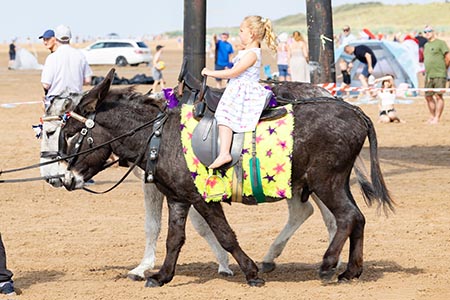
Donkey ride on a UK Beach.
In Wales, the Bridgend council recently banned all animals from Porthcawl's Coney Beach, ending a donkey ride tradition that had lasted a century. This is part of the council’s larger ban on animals, though flagging interest, animal rights campaigning, and economics (especially economics) have all played a role. Currently, ticket sales for donkey rides barely cover a year's worth of feed, farrier, and vet bills for the operation.
This is part of a broader pattern. Pony rides, carriage horses, and rodeos across the English-speaking world are being wound down by a variety of forces. And in a sad irony, this is all happening as our understanding of animals and standards of care are rising to unprecedented levels – and arguably, at a time when people, especially younger folks, are starved for hands-on interactions with non-pet animals.
There's a lot to be sad about as the donkeys go – the loss of tradition, the floundering economic model, and the wretched, baleful shadow of a worldview that frames any sort of interaction between humans and animals as "exploitative." What disappears with every closed pony ring, donkey ride, or retired carriage horse isn't just a quaint tradition, it's one more direct connection between people and the larger, living world.
Source: 'It'll be really sad if they disappear' - Are seaside donkey rides doomed?
The Value of Research for Research's Sake, Dog Bites Mail Carrier, and More!
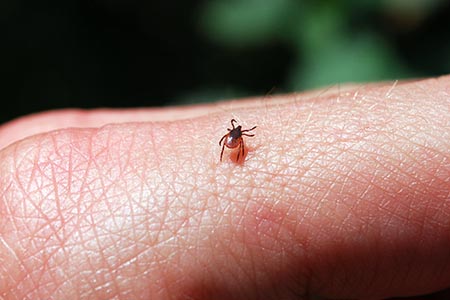
Being a tick must be an emotionally draining experience. You are literally never a welcome sight.
For many of us, the value of research is tied to its results: if a new treatment to slow the progression of Alzheimer’s proves to be effective, it has value; if the treatment does nothing to stall the disease, it’s a trip back to the drawing board. This binary leads many people to forget that research itself – regardless of findings – is still of great value. “Failures” sometimes deliver unexpected findings, opportunities for critical thinking or expanding the way we think, and sometimes the exercise and process of research itself leads to discoveries. This is something that students at the University of Nebraska at Omaha are learning as they study cortisol levels in dogs. Gleaning a deeper understanding of stress in dogs as it relates to behavior and health is certainly valuable – but even if the end results provide little of note, the education and ability to synthesize information that these students are gaining is invaluable.
Tick tock! If you’re looking for a reason to stay indoors this summer, look no further than Rhode Island’s laundry list of dangerous outdoor pests. This state features tick bites that give the gift of Lyme disease, anemia, organ failure, or even allergies to red meat and milk. It also has mosquitoes offering up the West Nile and eastern equine encephalitis viruses, as well as a host of rabid animals that are just salivating for a chance to bite you. Yikes!
OK, statistically it’s not actually that scary outdoors – and we do genuinely want you to go outside and enjoy yourself – but this is a good time to consider tucking pants into your socks when out in the brush, stocking up on insect repellent, and applying a bit of common sense when dealing with wild animals (i.e. please don’t pet that clumsy fox).
Next Monday, the United States Postal Service is kicking off a monthlong dog bite awareness campaign. Every day your mail is delivered, approximately 16 postal service employees are attacked by dogs, sometimes viciously. Thousands of carriers are unable to deliver mail to homes with aggressive and/or menacing dogs each year, as, well.
We don’t want to be cynical, but this awareness campaign probably won’t be received by the people who are most in need of having their awareness raised. However, it’s a super helpful reminder to folks who are, perhaps, a little lax in leaving their dogs loose during delivery hours! There is solid advice for mail carriers, too: the importance of making their presence known, a baseline assumption that loose dogs pose a threat, and how to position themselves in a way that prevents loose dogs from escaping fenced yards. We do question the advice to keep eyes “locked” on dogs. If this means being aware of where a loose dog is at all times, that’s great; if the suggestion is to maintain constant eye contact with potentially aggressive dogs, that advice is… well, that’s questionable. We’ll have to look into the specifics of that one when the campaign launches.
Regardless, this awareness campaign touches on a genuine problem that we are glad to see acknowledged outside of humor. It’s going to require a little bit of work and cooperation from both postal carriers and recipients, but it is definitely solvable in most cases.
Also in the News...
★ Argentina seizes 700 trafficked marine animals shipped from Kenya (Trafficking Busts; Illegal Exotic Trade Routes)
★ What is killing Sumatra’s elephants? The battle to save one of our rarest animals (Conservation vs. Deforestation; Charismatic Megafauna)
★ Winnebago Co. Animal Services in desperate need of kitten food donations (Rescue & Shelter Opportunities to Help; Cats & Kittens)
★ Multiple potentially rabid animals seen in Giles County (Public Health & Safety; Skunks & Foxes)
★ 3 service dogs boarded an American Airlines flight. A lawsuit followed (ADA Compliance & Lawsuits; Three Dog Flight?)
★ RFK Jr. wrangles snakes with bare hands in latest animal encounter (Caught on Camera: Very Different Views on "Hands-On" Animal Experiences)
★ 5 animals that can turn themselves inside out - from reversible anuses to exploding intestines (Gross & Goofy Lists; Unexpected Survival Strategies)
Click here to see what is happening legislatively