

Inside This Issue:
- Screwworm Now Infesting Pets as FDA Approves a New Treatment for Dogs
- Another Week, Another Elephant Personhood Case
- Bites: Another Elephant Story; Seized Puppies Returned
Screwworm Now Infesting Pets as FDA Approves a New Treatment for Dogs

We know we're not supposed to anthropomorphize, but she is clearly plotting something.
Arizona confirmed its first screwworm infection last week, joining Texas and New Mexico as the third U.S. state to report such cases. The U.S. has now recorded 74 recent animal cases. Most of those incidents have been livestock, but the number of pet cases is growing. Arizona's case was a dog in Cochise County, which borders New Mexico and Mexico. A local veterinarian examined the dog on October 26 and found a wound on its back that was "heavily infested with maggots." State officials urged livestock and pet owners to watch their animals closely and report unusual wounds right away. The United States Department of Agriculture confirmed the case and is working with Arizona on a joint response.
While the maggots we typically think of avoid healthy flesh and are generally harmless – or even helpful – screwworms are voracious parasites. Female flies lay hundreds of eggs in wounds and moist body openings. Their screw-shaped larvae bore into living tissue, causing severe and sometimes fatal infections. People are at risk, too. Mexico has confirmed 806 human cases and nine deaths since the flies were found in the country again.
On November 3, the FDA issued an emergency use authorization for Bravecto (fluralaner) chewable tablets to treat screwworm infestations in dogs and puppies that was developed by the pharmaceutical company Merck. Bravecto is already FDA-approved for flea and tick uses in dogs. It belongs to the isoxazoline drug class, which is safe for most dogs but has been linked to tremors, loss of coordination, and seizures. For that reason, it is available only by prescription from a veterinarian.
The FDA says most U.S. dogs face low risk because cases are confined to a limited area. Dogs that live in, travel to, or return from affected areas should be watched for visible maggots or foul odors in wounds, eyes, ears, nose, or mouth. Owners who see those signs should get their dog to a veterinarian immediately.
Screwworms were once endemic to the southwestern United States and Mexico, but were eradicated through a combination of science, international cooperation, and – perhaps most importantly – vigilant persistence. So the question is less about whether we can contain and eradicate the threat than whether we will. In the meantime, keep an eye on your pets, and keep them up on their preventatives!
Source: Flesh-eating screwworms spread to third state and are attacking pets
Another Week, Another Elephant Personhood Case
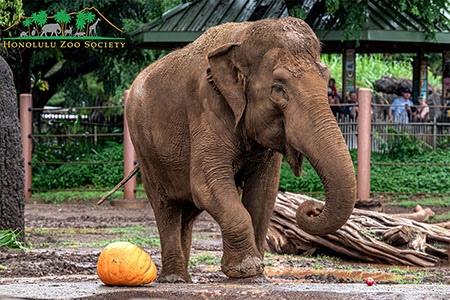
Glamor shot from the Honolulu Zoo
The Hawaii Supreme Court will hear arguments Monday, November 9, about whether two Honolulu Zoo elephants have a legal right to be set free. The case asks the court to treat animals as legal persons. This is just one of many similar cases brought by the Nonhuman Rights Project. This case was filed in 2023 on behalf of the two elephants, Mari and Vaigai. The Nonhuman Rights Project claims the animals, as legal persons under the law, have a common-law right to be free from imprisonment and wants them sent to an elephant sanctuary.
Two courts have already ruled against the Nonhuman Rights Project. Honolulu's First Circuit Court and the Intermediate Court of Appeals both ruled against the group, with Judge Keith Hiraoka writing that the common law treats "person" and "animal" as distinct legal concepts. The Supreme Court agreed in June to hear the case anyway.
The group has lost this argument multiple times, but continues to seek a favorable decision in any jurisdiction for the precedential value it would create. In a high-profile 2022 case, New York's highest court rejected the Nonhuman Rights Project’s petition to move Happy, an elephant at the Bronx Zoo, to a sanctuary and ruled that animals have never been considered persons with a right to liberty. That court – rightly – warned that personhood would disrupt property rights, agriculture and medical research, and would call into question pet ownership and the use of service animals. Of course, as far as groups like the Nonhuman Rights Project are concerned, that disruption is a key feature, not an unintended consequence of their efforts.
In the Hawaii case, Animal Rights supporters have filed legal briefs in support of the Nonhuman Rights Project’s arguments. Briefs opposing the Nonhuman Rights Project have also been filed. Most notably, the Association of Zoos and Aquariums (AZA), which accredits the Honolulu Zoo, filed a strong opposition. The AZA brief provides a well-thought-out argument related to the ʻalalā, a critically endangered Hawaiian crow, which survives today only because of captive breeding. The AZA contends that if confining elephants is legally wrong, confining ʻalalā would be, too. The birds would have to be released, and the species would likely go extinct. The ʻalalā example shows what is really at stake for all animal enthusiasts, not just the zoos, breeding programs, and professionals who are working to keep vanishing species from going extinct.
NAIA has long opposed legal personhood for animals. A court ruling establishing an animal as a legal person would not offer greater protections for animals, but would fundamentally alter our relationship with them for the worse. The law already protects animals and holds owners accountable for their care. A legal personhood finding would result in a flood of lawsuits filed in the name of millions of animals, quickly reaching farms, breeders, and family homes. Instead, let’s continue to use our laws to protect animals and ensure animal owners are held responsible for their care instead of seeking to create a legal fiction that removes our rights to co-exist with animals.
Source: Elephants go to court next week
Bites: Another Elephant Story; Seized Puppies Returned

Another glamor shot. This time, your friendly neighborhood Cane Corso.
Another elephant story: Tula-Tu, the Oregon Zoo’s one-year-old elephant, is showing encouraging signs after receiving emergency treatment for elephant endotheliotropic herpesvirus (EEHV). Her white blood cell count is nearly normal, her appetite and energy are improving, and her viral load is falling, an especially hopeful sign. She is being monitored around the clock.
EEHV is a potentially lethal herpesvirus that affects only elephants. Zoo staff detected subtle changes in Tula-Tu’s behavior early and began treating her with antiviral medication, fluids, and plasma transfusions. That care is possible in part because her keepers had trained her to accept blood draws, injections, and medication. Without that preparation and the zoo’s EEHV response protocol, her chances could be far worse.
Tula-Tu received an experimental mRNA vaccine last year targeting EEHV-1A, but her infection is caused by a related strain, EEHV-1B. It’s not yet known whether the vaccine offers protection against that strain. EEHV vaccines have also been administered to elephants at other facilities in hopes of preventing illness and supporting treatment efforts, including plasma transfusions. For now, the zoo is continuing to monitor Tula-Tu closely while she stays near her mother, Rose-Tu. We’re pulling for you, Tula-Tu!
Heads up! The Cane Corso breeder whose litter was seized after she posted a video that included docking her days-old puppies’ tails finally had the pups returned. Well, not to her. They were actually returned to the co-owner, who is understandably upset and angry over the entire incident. This chilling and infuriating tale includes lots of details: lawyering up; allegations of injuries and mastitis for the mother dog, plus improper medical treatment of the puppies while they were at the shelter; and an (unsurprisingly) “you will not sue” type of settlement in exchange for the puppies. Adding injury to insult, the returned puppies apparently have coccidia and possibly kennel cough. Ugh. Stay tuned: we’ll do a Q&A with the co-owner next week for a full rundown.
Also in the News...
★ Colorado voters reject amendment making hunting and fishing a constitutional right (Hunting & Fishing; Conservation; Animals & Elections)
★ Artificial nests help Hong Kong’s rare cockatoos cope with a ‘housing crisis’ (Conservation & Genetic Diversity; Human-Animal Conflict & Possible Concord)
★ Firework noise limit should be drastically cut to protect wild animals, UK government told (Human-Animal Conflict & Courtesy)
★ How a Moscow stray became the first dog in orbit — and an animal rights icon (History, Propaganda, and Animal Welfare)
★ 2026 AAHA One Health Guidelines: Emerging Concerns in Canine and Feline Parasitology (Parasites vs. Pet, Personal, and Public Well-Being)
★ Cameras will track animals using world’s largest wildlife crossing in California (Animal Conservation, Cameras, and Crossings)
★ Why Did Snakes Lose Their Legs? And 9 More Animal Mysteries (Informative Goofy Lists; Blue Frogs & Unsleepy Seals)