

Inside This Issue:
- Newsletter Subscriber Special: Sign up Today for the NAIA Conference!
- When an Elephant Falls, It Takes a Village... And Maybe a Tractor.
- Remembering Our 9/11 Search and Rescue Dogs
- News Bites: A Whole Lotta Chromosomes, Hero Teens Rescue Dogs, Foolish Tourists, and More!
Newsletter Subscriber Special: Sign up Today for the NAIA Conference!
See you next month!
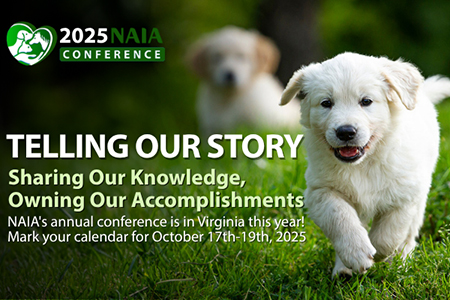
This year’s NAIA Conference, Telling Our Story, is just a little more than a month away, and it’s gonna be a barn burner! If you share your life with animals, come to Virginia Beach, Virginia, October 17-19 and learn how to tell your story. And as a special “thank you for reading” offer to our newsletter subscribers, we are inviting you to sign up for the conference at a $50 discount through the end of this weekend. Just enter the code NEWSLETTER25 at checkout. We can't wait to see you there!
Source: Sign Up Today for the 2025 NAIA Conference!
When an Elephant Falls, It Takes a Village... And Maybe a Tractor.
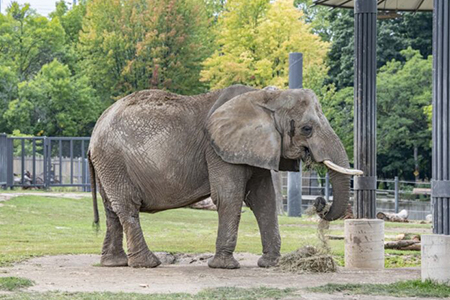
Ruth – on her feet. Milwaukee County Zoo.
Ruth, a beloved 43-year-old African elephant at the Milwaukee County Zoo, found herself in need of a little extra help on Tuesday morning. She got in a tussle with one of her herd mates (presumably over food) and took a tumble. Zookeepers sprang into action after seeing Ruth was unable to get up on her own, bringing in a front-end loader padded with hay to give Ruth the gentle nudge she needed.
If using construction vehicles seems a bit over the top for a live animal, consider that the zoo was working with an animal that often weighs over three tons, and that time was of the essence. Elephants cannot safely remain lying down for long periods. If they do, the sheer weight of their bodies can lead to injury and even suffocation. In the wild and in human care, elephants rarely sleep more than two hours at a stretch, precisely to avoid this danger. That’s why getting an elephant back on its feet is critical for its survival. And getting Ruth back on her feet quickly is exactly what happened here – to much applause and fanfare! (As a side note, John Deere might want to consider using footage of Ruth’s rescue in an upcoming ad campaign.)
Zoo officials credited the successful rescue to the team’s extensive training and experience in elephant husbandry. Keepers at Association of Zoos and Aquariums (AZA) institutions, like Milwaukee County Zoo, complete specialized courses in elephant management and regularly participate in hands-on emergency drills with other zoo departments, as well as local police, fire, and crane operators. The coordinated effort paid off. Ruth is being monitored, and appears to be doing quite well, a testament to the expertise and dedication of her caretakers. Incidents like this highlight the importance of ongoing training and collaboration, ensuring that elephants like Ruth continue to thrive in human care.
Source: An Update on Elephant Ruth
Remembering our 9/11 Search and Rescue Dogs
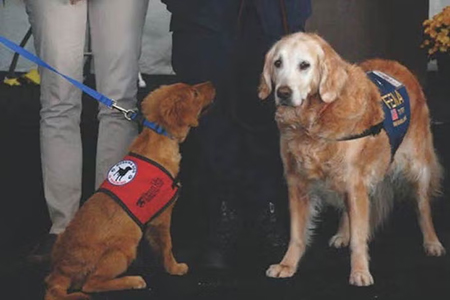
Bretagne meets a working pup that was named in her honor ~ 2012
In the chaos and heartbreak that followed the 9/11 attacks, as first responders rushed into danger and families waited for news, another group of heroes quietly took their place among the brave. The search and rescue dogs who joined the recovery efforts at Ground Zero became a symbol of hope and resilience, working tirelessly alongside their human partners to bring solace and closure to grieving families. These purpose-bred dogs navigated twisted steel and unstable rubble, relying on their keen senses and unbreakable bond with their handlers.
Day after day, they pressed on, offering not just their skills but also their presence: a comforting reminder that loyalty and love endure even in the darkest moments. We are closing in on a decade since Bretagne, the last 9/11 search and rescue dog, passed, but the stories of these dogs have been preserved – not just in memory, but at the 9/11 Memorial and Museum at Ground Zero, where the “Dogs on 9/11” exhibit pays tribute to these remarkable animals and the handlers who stood beside them. The exhibit captures the unbreakable bond between humans and dogs, reminding us that in times of unimaginable loss, our most loyal companions are there to help.
Sources: The Lasting Impact of the Dog Heroes of 9/11, Four-Legged 9/11 Heroes
News Bites: A Whole Lotta Chromosomes, Hero Teens Rescue Dogs, Foolish Tourists, and More!
That's a big chicken.
If you ever want to feel like your chromosome count is insignificant, just hang out with an Atlas blue butterfly. These animals carry a record-breaking 229 pairs of chromosomes! This may be due to a turbulent 3-million-year evolutionary history where the butterfly’s 24 chromosomes split multiple times, essentially “compartmentalizing” its genetic information into the grand number it boasts today. Whether all this complexity is helpful to the species – at least short term – isn’t currently understood. Generally, extreme genetic fragmentation like this is beneficial for a species. Scientists are eager to unravel the cause of this fragmentation, its effects on the butterfly’s long-term ability to survive, and how this understanding may be applied in the realms of animal and human health.
Three teenage boys who kicked down the door of a burning home to rescue a family’s dogs were recognized for their bravery this week. After two homes caught fire, the teens rushed to make sure nobody was home, at which point, they noticed two dogs trapped inside one of the homes. While it’s normally advised not to enter a burning home, the trio couldn’t just stand by and let the dogs burn to death – an act of courage that has earned them the admiration of the community and eternal gratitude from the dogs’ owners!
If you’re a non-native species in New Zealand, you might want to book a flight to Europe or Australia. New Zealand’s Predator Free 2050 program promises to eradicate tens of millions of invasive predators, with a goal of making life safer (or simply possible) for the country’s remaining native species. Humans are not included on the list, but rats, stoats, and possums should be terrified. This is a particularly brutal method of conservation, but given that the situation for numerous native New Zealand species is essentially “will soon be extinct in the wild unless immediate action is taken,” supporters of the Predator Free 2050 program feel there is no other choice.
The headline says this tourist, who is snapping pictures right next to a ginormous bull elk, is behaving in a “frustrating” manner, and boy, ain’t that the truth. It happens all the time, no matter how many unfortunate encounters are documented each year. We get it – appreciating nature feels great. Conservation is an honorable goal. And photographs of wild animals are super! But for everybody’s safety and peace of mind, can we please, please, please, stop acting like we’re starring in a 1950s Disney movie, and give wild animals a little bit of proper respect and space?
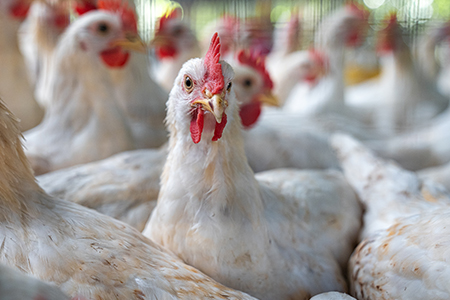
Here's an interesting yet somewhat ominous observation on animal life over the last millennium: some animals have gotten smaller, while others have gotten a lot bigger. Which ones are smaller, you ask? That would be wild animals, like foxes and deer. And which ones are bigger? Domestic animals – and sometimes by a whole lot (just look at the broiler chicken diagram). The largest and most obvious driver here is human activity – and what dramatic results (again, just look at the broiler chicken diagram) this activity has wrought!
We regularly discuss endangered animals, but there are new animals being discovered regularly, too. Recently, three deep sea species of snailfish were discovered off the coast of California, and at least one of them resembles a beloved character from Avatar: The Last Airbender. Aside from being a pretty neat discovery, it’s a reminder that no matter how many corners of the earth we explore, there’s always something new and wonderful to discover.
Also in the News...
★ Hackers steal thousands from small Georgia dog rescue, leaving animals at risk (Hacking, Scams, and Identity Theft)
★ Tarentum animal rescue installs 24/7 microchip reader for lost pets (Rescue & Shelter News; Keeping People & Pets Together)
★ Fast-growing brains may explain how humans—and marmosets—learn to talk (Just Some Quick Babbling About Evolution)
★ Animal neglect leads to growing homeless cat population (Feral Cats; Animal Policy; Big Hearts & Inexperience)
★ Lizard gives birth without mating in 'one of rarest events in animal kingdom' (Herp News; Parthenogenesis)
★ ‘Feces everywhere’: Neighbors recall living next to Whitley Co. home with 33 animals (Hoarding, Neglect, and Generally Unneighborly Behavior)
★ 10 Deadliest Deep Sea Fish That Are Aggressive Hunters (Fun & Goofy Lists; Underwater Slideshows)
Sign up for the 2025 NAIA Conference Today!
Click here to see what is happening legislatively