

Inside This Issue:
- An Abandoned Macaque and the Importance of Belonging
- When the Next Treatment for Your Autoimmune Disease Comes Out... You Might Need to Hug a Llama.
- Shelter Scammers, a Horse's Whinny, and More!
An Abandoned Macaque and the Importance of Belonging
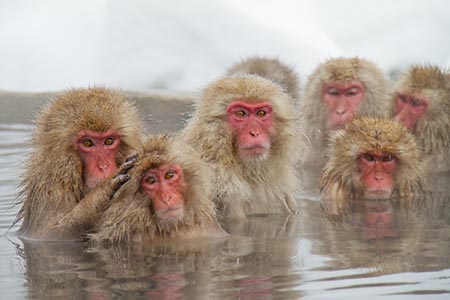
A troop of Japanese macaques, also known as "snow monkeys."
When we think about animals that evoke strong emotions in people, the plaintive cat and sad-eyed shelter dog are usually the first animals that pop into our minds. Those four-legged friends are the gold standard for a reason. But it turns out that hardly anything pulls on the heartstrings like a rejected, “bullied” baby monkey whose only friend is an IKEA orangutan plush.
You’ve probably already heard the story of Punch the monkey numerous times, so we’ll keep it to a short summary. Punch is a little Japanese macaque at Ichikawa City Zoo in Japan. Early on, Punch struggled; he was abandoned by his mother and just couldn’t connect with the other monkeys, so he was given a stuffed orangutan for comfort. That little stuffy made all the difference in the world for him. For a while, that plush friend was his whole world; he’d cling to it, drag it around, even sleep beside it – just like our kids do with their favorite stuffies. But for a social creature like the Japanese macaque, a stuffed animal is no substitute for companionship. Seeing Punch get “bullied” or “scolded” by other macaques, then retreat back to his stuffy was worrisome and heartbreaking for viewers on social media, who just wanted to see the poor little guy accepted into the troop. This is something all of us can no doubt identify with!
Recently, however, something clicked. In the most recent videos, he is being groomed by another monkey, a major milestone for his acceptance into the group. Grooming is a way of saying, “You’re one of us.” It’s heartwarming to watch him slowly make his way into the troop, learning the ropes of macaque society. For those that work hands-on with animals, it’s a reminder: sometimes, the best rehab tool isn’t just medical care or special diets, but helping an animal feel like it belongs again. None of this would have been possible without the care and compassion of the zookeepers and staff who helped Punch connect with his troop and used their expertise to create a safe space for him to thrive.
Source: Why Punch the monkey updates, rejection hit us so hard
When the Next Treatment for Your Autoimmune Disease Comes Out... You Might Need to Hug a Llama.
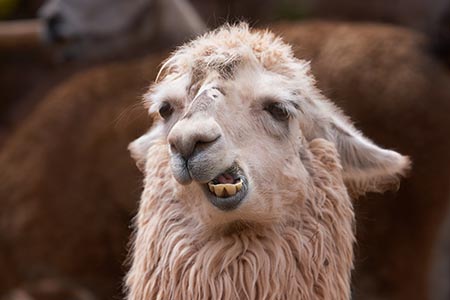
From the Andes, a hero arises.
Living alongside animals teaches you that their value goes far beyond anything we might imagine. Spend any amount of time with llamas, New World camelids hailing from the Andes, and you’ll see this firsthand. On a farm in Belgium these curious fluffballs lounge in the sun, trudge up hills, and greet visitors with gentle nudges – but their real magic happens behind the scenes, or rather, on a microscopic level. Here, llamas are vital partners in groundbreaking medical research.
Their unique immune systems produce tiny, adaptable proteins called nanobodies that are helping scientists tackle some of humanity’s toughest health challenges, from cancer to chronic pain and autoimmune illnesses. It’s a quiet revolution powered by cooperation and trust: while the llamas graze and roll in the dirt, they’re also contributing to new medicines and advances that could save lives. Those who care for them know that this relationship is built on respect. The animals are well looked after, and when their work is done, many enjoy peaceful retirements or new roles as guardians or even in wildfire prevention. There’s a sense of awe in witnessing what animals can provide besides just food or fiber, but hope for a healthier future. Honoring their contribution means seeing them as true collaborators in addition to being beasts of burden, whose lives and talents deserve our deepest gratitude.
Source: Llamas may unlock new drugs
Shelter Scammers, a Horse's Whinny, and More!
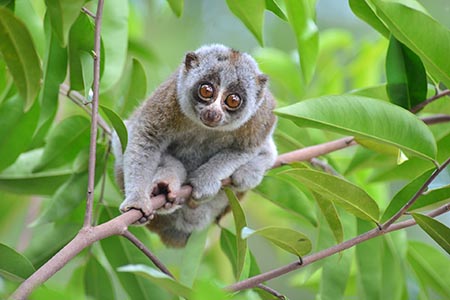
Adorable... but venomous and quite territorial.
In this week’s installment of “Issues We Could See Coming from Light-Years Away,” the San Jose Animal Care Center (SJACC) is being inundated with desperate calls and messages about dogs they are about to euthanize… only these adorable-yet-tragic dogs aren’t real: they are AI-generated scams, and they’re understandably really upsetting a lot of people. SJACC wants to make it clear that they are NOT euthanizing dogs for space, nor do they post heart-rending images of dogs that "must be adopted in 48 hours – or else."
This is a reminder of how vitally important it is to verify the legitimacy of the calls to action or donation pleas that pop up on your screen. Even if the logo, profile, website, or email address seems to match up, don't take it at face value – double and even triple-check it if you have to. It’s such a nasty trick on everybody. Even when the fake dogs in these manipulative scams fail to separate kind-hearted marks from their dollars, they cause genuine stress and emotional pain in viewers. These scams also divert rescues and shelters from their mission as the misrepresented party is forced to spend energy putting out fires and responding to public outcry, rather than focusing on animals and adoptions.
One of the more painful truths about rehabilitating wild animals is that no matter how hard you work, no matter how badly you want a good outcome, many of them can never be safely released back into the wild. When it comes to wild animals rescued from animal traffickers, a new study shows that odds for successful release can be worse. In fact, for some animals, reintroduction may be akin to simply dropping them in a death trap. In this case, we’re talking about Bengal slow lorises, an adorable nocturnal critter that is also the world’s only venomous primate, and super popular in the illegal pet trade.
Sadly, of nine lorises that were recently tracked after being reintroduced, seven were dead in less than half a year. Yikes! Four of the bodies were recovered, all of them covered in bites and scratches from native lorises, a hint that the locals didn’t appreciate interlopers. Another strong clue: the only two surviving lorises made a beeline out of the area they were dropped in – future reintroduction efforts will have to be diligent to help these animals avoid deadly territorial disputes. While these findings were disappointing, the information is extremely valuable, and helps to provide conservationists with a path forward. Without the observations, we might still be sending these guys off to their death.
To most of us, a horse’s whinny is one of the most delightful and instantly recognizable sounds on the planet. But have you ever stopped to think about it – to really analyze it? It’s actually kind of weird when you do. It emanates from one animal, yet contains two distinct parts: a low grumble and a high-pitched whistling sound that is much "squeakier" than what you'd expect from such a large animal. This duality has apparently flummoxed scientists for eons (OK, maybe since 2015), with an explanation for the phenomena only coming recently. It’s a combination of rumbling in the vocal cords while the distinctive whistle is produced by pushing air through the voice box. This is a pretty neat trick, and horses aren’t the only animal that can pull it off. Mice can do it, too – it’s just that their whistling is too high-pitched for us to hear.
Wyoming is considered one of the capitals of individualistic live-and-let-live liberty in the United States, but don’t call it a Mecca for exotic animal owners. This story about pygmy goat bans and reinstatements, and the need for exotic animal owners – especially folks with “scary” animals like snakes – to remain vigilant, even when there are no bans in play is a good read, and really has something for everybody. There’s an animal law research fellow lamenting the fact that animals don’t have rights, a mention of the good work done by our friends at USARK, a charismatic mayor who is extremely proud of his goat statue, a pleasant, if ambiguous ending... and best of all, loads of cute pygmy goat pictures. Go ahead and give it a read!
Also in the News...
★ MSPCA-Angell evacuates nearly 50 animals, opens shelter to pets from Cape homes without power (Rescue & Shelter Emergencies)
★ ‘Never easy to say goodbye’: Beloved Peoria Zoo animals euthanized due to health issues (Zoo Life & Death; Sad Farewells, Age-Related Euthanasia)
★ Fast-paced lives demand faster vision: Ecology shapes how 'quickly' animals see time (Evolutionary Surprises; More than Just a Difference of Perspective)
★ A Syracuse AI company aims to ‘talk’ to the animals to keep them off train tracks and highways (Technology; New Approaches to Animal Health & Welfare)
★ City of Rogers to Partner with Humane Society to Provide Free Spay and Neuter Services for Residents (Pet Care Assistance; Free/Low-Cost Spay and Neuter)
★ 'Home of Queer Animals': University of South Alabama operates 'queer animal research' lab (Same-Sex Behavior, Non-Monogamous Mating Systems, and Intersex Traits )
★ Can You Adopt A Wild Animal As A Pet In Michigan? (Fun and Ill-Conceived Lists; No, You Can NOT Keep a Black Bear in Your Living Room)
Click here to see what is happening legislatively