

Inside This Issue:
- A Full House for the Holidays
- Bella, It's Cold Outside
- San Antonio Acting on Dangerous Dog Reports
- Delaware's Doomed Dog Walking Mandate
- Bugs, Bugs, and More Bugs!
A Full House for the Holidays
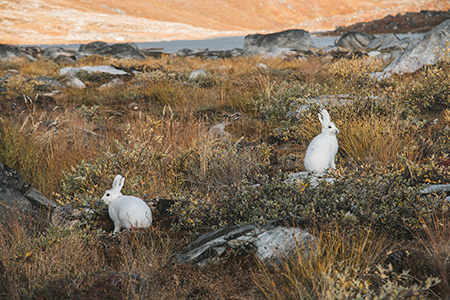
Arctic hares in Greenland, near the Arctic Circle. You must admit, it would be pretty hard to sneak up on them.
We’ll be hunkering down for Christmas next week, so this following story feels appropriate…
Humans aren’t the only species that become more social in winter – many animals do it too, though probably not for holiday festivities. As temperatures drop and food becomes scarce, different creatures deploy various strategies to cope: some migrate, others insulate themselves with dense fur or fat, and some come together to form protective groups.
Brandt’s voles of Inner Mongolia, for example, spend their summers alone, but you can find them huddling together in small, underground groups when the freezing winter winds hit – what a cozy way to save energy! Similarly, Barbary macaques – already a social species – come together for thermal regulation during the cold, but the catch here is that the most social or “appreciated” macaques enjoy larger huddles when it is icy out. This is an example of social butterflies becoming even more social when it suits them – and a reminder that it pays to be liked!
Animals don't come together just to lower the heating bills, though. The mostly solitary Arctic hares of Canada become more social during the winter as a kind of security arrangement: forming a large group makes it harder for predators to single one of them out and lets each hare spend more time searching for limited food, since there are so many additional eyes checking for threats. Meanwhile, let’s not confine this behavior to mammals! Insects like ladybugs also benefit from winter clustering, huddling in dormant clusters to conserve moisture and energy while making their warning coloration more obvious to predators. And finally, let’s not forget the red-sided garter snake, a reptile that winters over in a packed hibernaculum to survive the cold, then uses its convenient proximity with others to mate-and-run as quickly as possible when the weather warms up again.
While we now view our winter gatherings as social occasions, they more than likely began as a reason to stay warm, safe, and share resources. We just gradually structured music, games, and storytelling into the tradition (along with rum laced eggnog). Ultimately, these seasonal gatherings, whether for warmth, safety, food, conservation, reproduction – or all of the above – are about boosting each species’ odds of surviving the cold and dreary challenges of winter.
Sources: Humans aren’t the only animals that gather to hunker down together at Christmas
Bella, It's Cold Outside
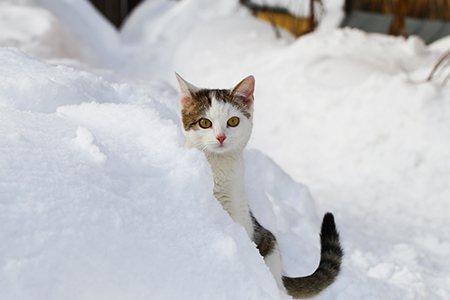
This is Bella.
Speaking of surviving the cold and dreary, it’s time for our annual “Hey, let’s make sure our animals are warm!” reminder. As we stay indoors and snuggle by the fire, here's some expert veterinary advice on how to keep pets and other animals safe outside while Jack Frost does his dirty work...
Because our pets still need exercise and social time, we brave the cold to meet their needs. Most dogs handle it well and stay warm while running around. However it is important to be on the lookout for hypothermia. Signs to watch for include shivering, trouble walking, and a wobbly stance. Realistically, this is only going to be a serious concern for a tiny number of dog owners, especially given how often the average American walks their dog (see the story below). Still, vigilance is important, especially with dogs that have short coats or other risks for cold-related issues. Additionally, cold is more of a danger to dogs that are very young or old. It is also recommended to check ears, tails, and toes for frostbite, since those areas get the coldest. Booties can help protect paws, and it’s a good idea to avoid places where de-icing chemicals are used.
Animals that spend more time outside need extra food and water, and owners should make sure neither freezes (remember, those extra calories help warm-blooded animals thermoregulate). If you’re setting up a shelter for outdoor cats, use straw instead of blankets. Straw won’t freeze if it gets wet, making it safer in cold, damp weather. One more tip: if you see snow building up on an animal’s fur, that means their coat is keeping warmth in and the cold out - the way it’s supposed to work. And if possible, a donation to a local pet food pantry always helps support animals in need – during the cold winter months and beyond!
Sources: Greenville veterinarian shares ways to keep animals safe in cold temperatures
San Antonio Acting on Dangerous Dog Reports
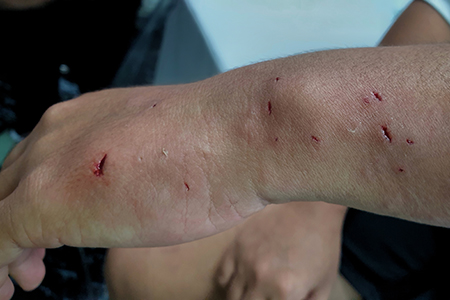
At least this bite didn't lead to a lost digit. Roaming dogs are a serious public health and safety issue.
San Antonio has seen a sharp uptick in reports of dangerous dogs, with complaints to Animal Care Services nearly doubling in the past year. This jump is closely linked to increased citywide awareness, reinforced messaging, and new laws passed after a string of serious dog attacks. The city now maintains a public, searchable registry showing the locations of dangerous dogs. As investigations and designations of dangerous dogs have risen, more owners have to comply with stricter requirements, like secure enclosures, signage, and microchipping, when their pets are labeled dangerous.
The city has achieved an 80% compliance rate thus far, which is good considering the challenges of tracking down noncompliant owners that move or hide from the law. Since 2024, San Antonians can file dangerous dog complaints under a pseudonym if they fear retaliation – a step that only a few have used so far, but which city officials hope encourages more reporting. That same set of new laws adopted last year also raised penalties for repeat or serious bite cases and allows ACS to sterilize loose dogs before returning them to owners. We are fine with sterilization requirements for dogs that have already been deemed dangerous for repeat or serious offenses; sterilization of loose, owned dogs is obviously very problematic.
All together these efforts, while not perfect, are promising, and show that the city is acknowledging this longstanding issue and taking active and much-needed steps toward maintaining public health and safety.
Sources: Dangerous dog filings double as San Antonio residents report more incidents
Delaware's Doomed Dog Walking Mandate

How many dog walks does this count as?
PeTA, as a bunch of self-proclaimed "press sluts," typically errs on the side of shocking and outrageous with its campaigns. This tendency makes their current efforts in Delaware, a bill that would give dogs a “right” to be walked three times a day, seem rather tame. There’s no gore, no sex – heck, it doesn’t even pit children against their parents. Tsk Tsk. Disappointing. That said, their proposal does a truly bang up job of transforming walking the dog – a beloved institution that many of us (especially our dogs) wish we had more time for – into a snarling, authoritarian-yet-untenable mess. So from that standpoint, at least, the proposal is quite impressive.
The bill PeTA is pushing would mandate three walks per day for dogs, with one of the walks lasting for at least 60 minutes. Every day. And if you don’t walk Luna, you’d have to pay a big fine or suffer a major penalty of some sort. Now, we all know on a gut level that most American dog owners don’t take their pooches for three walks per day. One recent survey put the national average for dog walks at just over one per day – and those walks were self-reported, so it’s fair to assume there is some “step inflation” going on in the numbers. So let’s be real – given people’s current habits and lifestyles, declaring anything less than three walks per day illegal isn’t going to do anything other than criminalize a large swath of the dog owning population.
To be clear, we don’t take the proposal itself seriously. Even if it were passed as a bill – which is extraordinarily unlikely – it’d never be enforced. Turin, the city PeTA lauds when touting this idea, has apparently never rigorously enforced its own groundbreaking mandatory dog walk policy. Heck, like many municipalities, it can’t even enforce its own pooper scooper laws.
What we do take seriously, is the larger issue in animal care that this proposal represents – the pernicious belief that you can snap your fingers and legislate yourself a beautiful new reality. We can’t think of a single example of where this idea has been helpful. However, we have seen it cause good people to retire from animal hobbies and enterprises because they don’t want to become “criminals.” We have seen it push borderline and bad actors underground, where they no longer face any type of oversight – leading to worse outcomes for animals and consumers. We have seen problems that this idea claims to solve persist – because just saying something is “over” doesn’t make it so. And, time and time again, we have seen unintended consequences that only serve to make a supposed problem situation even worse.
Walking our dogs is a beloved institution, and most of us wish we had more time to take Max out for a stroll. It’s fun, it burns calories, it never hurts to get off our screens for a while, and our dogs fricken’ love it! But should it be legally mandated? Heck no. If we want to change behaviors, and ultimately the culture of dog walking, the very first thing we need is to make sure dog owners have spaces available where they can safely walk their dogs, and hopefully enough free time to do so. Starting from a place where we mandate unrealistic requirements for pet owners is a cynical, unhealthy non-solution. It may grab some headlines, but it has literally never solved a problem.
Source: Animal rights group wants dog-walking law in Delaware
Bugs, Bugs, and More Bugs!

This rarely ends well for both parties, but a newly discovered species of praying mantis may have cracked the code.
Male praying mantises face a tough quandary: “Should I pass on my genetic material to the next generation or would it be better to avoid getting my head bitten off and be made fun of in a video short?” With nature being what it is, many, if not most of these male mantises opt for likely decapitation. But with the snake-tail mantis, a newly discovered species of dwarf mantis named after its distinctive courtship dance, scientists theorize that this species’ males appear to have found a way of avoiding sexual cannibalism: be a good dancer. Now if that's not a lesson for every guy out there, we don't know what is.
Speaking of insects, we already knew that mosquitoes have a great sense of smell, that they prefer biting some people over others, and that the foods we eat can play a factor. But did you know that mosquitoes can lock onto a human target they really like and follow that person, waiting for the right moment to take a bite? As annoying (and deadly) as mosquitoes can be, you have to admit that these findings aren’t just fascinating – they’re kind of impressive. And it could mean good news for us, too, as a better understanding of the smells that mosquitoes prefer helps us to build better lures and repellents.
More bug stories, you ask? If you read our weekly roundup, you probably already know this, but screwworm is now within 70 miles of the United States border. This parasite used to be common in the US, but was eradicated six decades ago, back when miraculous feats like political and international agreements based upon common interests were possible. While the hook-mouthed worm itself is kind of gross to look at, it is the painful wounds and infections – and death – it causes that demonstrate its true danger. The enormous welfare and economic risks it poses to animals and animal agriculture cannot be understated.
Also in the News...
★ Killer dog pack in Katy leaves one man dead, mother injured while saving toddler (More Dangerous Dog News)
★ It Looks Like a Frog, but It’s a Bug: Scientist Discovers 7 Unusual New Insect Species (New Findings; In Case You Weren't Sick of Bug Stories)
★ Sarasota content creator under investigation for animal cruelty video (Being Nasty to Opossums for Clicks)
★ Ban live reindeer events at Christmas, says animal welfare charity (Of Course They're Saying That)
★ Animals safe after flood evacuation at historic Briscot Farm in Kent (Massive Rescue Effort)
★ Once a Year the French Literary Scene Goes to the Dogs (Cats, Too) (Animals in Literature; Public Opinion; Animal Rights Philosophy Creep)
★ See stunning photos of animals and nature captured by AP photojournalists in 2025 (Fun & Beautiful Lists; Photography)
Click here to see what is happening legislatively