

Inside This Issue:
- The Great Veterinarian Shortage: Farm Edition
- Horseback Rides Return to Central Park
- Elephant Rampage and Efforts to Reduce Human-Elephant Conflict
- A New Old Species, Self-Domestication, Stressful Sights, and More!
The Great Veterinarian Shortage: Farm Edition
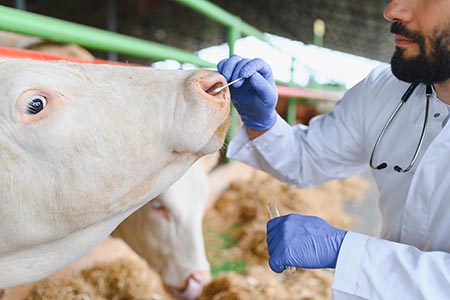
Would you wipe this cow's nose to wipe out $25k of student loan debt?
Among pet owners, the shortage of veterinarians in the United States is a pretty well-known problem. However, this shortage is hitting farmers and agricultural animals even harder. New data illustrates the severity: over 500 counties across the country don’t have enough veterinarians to care for their livestock. This is bad news for animal health and well-being, and it obviously harms the livelihood of farmers and their communities. A less immediate, but even larger issue is the threat to food security and public health that inevitably increases as it becomes more and more difficult to provide sufficient veterinary care to agricultural animals.
According to the experts, there just aren’t enough students getting into large animal veterinary medicine, a problem that is driven by multiple factors. One of the biggest issues is that a lot of graduating and younger veterinarians just don’t want to live in rural areas and/or work with large animals. To some extent, this runs counter to the post-COVID polls that showed a large number of Americans wanting to “move out to the country,” though it is worth pointing out that a desire for rural life skewed highest in these polls among people over the age of 55 – probably not a demographic that is going to produce a lot of new large animal veterinarians. Another important issue to consider is that working with agricultural animals is, quite frankly, a very hard job – especially the emergency calls. Also, due to the shortage of services, there will be a near-constant demand for a large animal veterinarian’s skillset. For many people, that kind of demand will inevitably be stressful – perhaps even unacceptable. If you listened to our podcast with Dr. Arnold Goldman, you heard him talk about how today’s young and graduating veterinarians place a higher value in work-life balance than previous generations. This wasn’t meant as a shaking-fist-at-clouds critique of “kids today” – balance and boundaries are healthy – merely an acknowledgement of reality that, we hope, helps to explain the job’s lack of curb appeal.
While the lack of veterinarians is a tough issue, there is hope. As you read above, the problem has been acknowledged and numerous possible causes have been identified. Additionally, important steps are now being taken to alleviate the shortage. The Veterinary Medicine Loan Repayment Program offers cold, hard cash – always a favorite – as incentive for veterinarians to work in rural areas, and the USDA is expanding its efforts in this department, as well. Mere baby steps? Perhaps, but this shows the problem is being taken seriously, and, more importantly, that action is being taken.
Sources: Large animal veterinarian shortage threatens agriculture industry
Horseback Rides Return to Central Park

Horse!
A new horseback riding venture is set to launch in Central Park, even as animal rights activists continue their push to keep horses of any kind out of Manhattan. Miller’s Horse Co., working with Manhattan Saddlery, plans to reintroduce guided rides along the park’s Bridle Path, reviving a tradition that dates back to the days when horses were essential to the city’s daily life. For over a century, horses shaped New York’s streets, hauling everything from people to freight, and left a permanent mark on the city’s layout and culture.
While private owners and small groups have occasionally organized rides since the closure of the historic Claremont Riding Academy in 2007, this marks the most significant return of organized equestrian activity in the park in years. The horses for this new program will be transported in from outside the borough, with the company emphasizing that the animals’ routines include ample rest, daily care, and regular veterinary attention. Rides will be small and guided, with strict adherence to rules about working hours, rest breaks, and weather conditions.
The plan has faced predictable resistance from animal rights activists, though at least for now, tradition and the human-animal bond are succeeding against the cries of a rabid few. The return of horseback riding to Central Park serves as both a nod to New York’s past and a welcome reminder that the human-equine bond has a place in modern society, too.
Sources: Horseback riding coming back to Central Park — even as activists work to get carriage rides banned
Elephant Rampage and Efforts to Reduce Human-Elephant Conflict

Majestic and oddly beautiful, but not a welcome guest in your home or garden.
Authorities in eastern India are frantically searching for a solitary Asian elephant responsible for a series of nighttime attacks in Jharkhand that have left at least 22 people dead since the first of this year. The incidents have shaken rural communities, as the elephant moves unpredictably through forested areas and villages, making it difficult for officials to contain the threat. Hundreds of forest department workers are now involved in efforts to track the animal, which has thus far managed to evade capture.
This crisis is not just a story of a rogue elephant, but a stark reflection of the ongoing conflict between humans and elephants, which is now recognized as the leading cause of death for Asian elephants across their range countries. As forests shrink and become increasingly fragmented due to agriculture, mining, and a growing human population, elephants lose access to their traditional migration routes and food sources. Forced into closer contact with people, they are more likely to wander into villages, raid crops, and, in some tragic cases, attack humans. The challenge becomes even more acute when dealing with adult bulls, particularly if they are in musth – a periodic condition marked by heightened testosterone levels, unpredictable behaviors, and surging aggression.
The situation in Jharkhand is part of a much larger pattern seen across Asia. In southern India, rapid urbanization and unplanned infrastructure projects have squeezed elephants into smaller spaces, making dangerous encounters more frequent. Other risks tied to human activity, such as collisions with trains, electrocution from exposed power lines, and the growing problem of elephants foraging in open garbage dumps, are all forms of human-elephant conflict (HEC) that threaten both human lives and the long-term survival of elephants.
Efforts to reduce these deadly confrontations are underway in every region where elephants are found. For example, in Sri Lanka, buses now help rural residents travel safely through elephant habitats, reducing the need to walk along roads where elephants might be present. Experts agree that keeping wildlife corridors open and connected is essential, as elephants are migratory and rely on these pathways to move between feeding and breeding grounds. Without such measures, isolated groups become more stressed and aggressive, escalating the probability of conflict.
Another highly effective and humane tool for managing dangerous elephants has been the use of “kumkis” - trained elephants that work alongside mahouts and forest officials. These kumkis are skilled at guiding wild elephants away from villages, calming agitated animals, and even assisting in rescue or relocation operations. Their presence often helps defuse tense situations without resorting to lethal measures, and their success has made them a model for other Asian elephant range countries. Nations such as Thailand, Myanmar, and Sumatra have also adopted the use of trained elephants in their conflict mitigation strategies, using them to shepherd stray herds back into forests or to intercept lone bulls before they can enter populated areas. These programs, when combined with community awareness and habitat management, have demonstrated that traditional knowledge and innovative partnerships can play a crucial role in reducing human-elephant conflict across Asia.
The recent attacks underscore the urgency of finding solutions that protect both people and elephants. Addressing the root causes, such as habitat loss, infrastructure that allows or encourages human-elephant interactions, and a lack of safe migration corridors will be critical if these animals are to survive alongside growing human populations. The tragedy in Jharkhand is a warning, but it also a chance to rethink human and elephant coexistence.
Sources: A Deadly Elephant Rampage Highlights Growing Human-Wildlife Crisis
A New Old Species, Self-Domestication, Stressful Sights, and More!

Minimal Jitters.
Sporting a colorful and highly contentious paleontological history that spans back to the mid-19th century, the extinct and inappropriately-named genus Prototaxites is routinely rediscovered by researchers as additional facets of its biology and history are uncovered. 400 million years ago, these towering fungus (or fungus-like) organisms were the tallest living structures on earth, growing to a massive 26 feet tall. If you had a time machine and could deal with the exceedingly thin air, wandering through a Prototaxite copse would no doubt feel unsettling, even alien. Couple that with a long history of debate surrounding the genus’ true nature (“Is it a tree? An algae? Are we looking at a giant fungus?”), and you can see why the interest has been sustained. Now, however, we may have an answer: it’s not a tree, algae, or (as is commonly believed today) a fungus, but a unique form of life that, up until now, had never been recognized before. That’s a pretty wild claim – but it is backed by research, and frankly, it helps explain many of the Prototaxites' peculiarities. Is the ol’ Six Kingdom model due for an update?
Earlier this week, Dr. Brenda Brown-Carlson, a Portland, Oregon veterinarian who stole pain medication meant for animals, was sentenced to five years of supervised probation. The five years is part of a plea deal, and during this time, Brown-Carlson cannot work as a veterinarian or for businesses that treat animals – she’s basically only allowed to be around her own pets.
Suspicious co-workers caught Brown-Carlson diluting drugs with saline on camera – tampering that reduced the pain treatments for over 200 animals, breaking a vital bond of trust between animal owners and their veterinarians.
Recent observations that suggest raccoons are on the path of “self-domestication” have raised a lot of questions and opened up twin cans of scientific and philosophical worms (no, we are not trying to domesticate the giant Gippsland earthworm). With that in mind, Gizmodo decided to ask a few scientists which animals they thought might become pets. The answers aren’t shocking or even that provocative, but they were informative and demonstrate fascinatingly different views toward animals and humanity’s relationship with the natural world.
An exploration of what happens to long-lived animals when they are able to gracefully slide into old age rather than spend their entire existence struggling to survive and reproduce raises questions about aging in animals. Perhaps more importantly, it asks what the geriatrics of the animal kingdom might teach us, to help improve and extend our own lives...
For the 2026 season, the State Fair of Texas is putting its rodeo events on hold - a tough, but not unprecedented call. Texas has a long and storied relationship with horses, from ranch life to the heart-pounding energy of rodeo nights under the Fair Park lights. As any longtime fairgoer knows, this isn’t the first time the rodeo has stepped back, and history shows the tradition never really disappears; it just waits for the right moment to ride again. Fair officials say that rising costs have made it too hard for many Texans to attend, which harms its top priority of making the events accessible to as many people as possible. However, the State Fair of Texas wants us to remember that this isn't forever: "This isn’t goodbye - it’s just so long for now."
On a tiny, remote island near Zanzibar, scientists implanted bat brains with “neural logger” devices that tracked the bats’ locations and brain activity as they learned to navigate new terrain. These experiments revealed that bats, like other mammals, rely on an internal compass built from brain cells that respond to landmarks, rather than magnetic fields or the stars. This supports the theory, previously shaped by decades of lab work with rats, that mammals create mental maps anchored by features in their environment. Humans share similar brain structures, though our navigation skills seem increasingly unreliable as we rely more on GPS and digital maps (the blessing and curse of technology). While this research is fascinating, it’s not curing any ailments that afflict animals or humans at this time – the main benefit has been a demonstration of the massive amount of data that can be gathered from studies in the wild, compared to the lab.
We’ve brought up the fact numerous times that, for many people, seeing an animal suffer on screen – especially a dog or cat or defenseless wildlife – can be more upsetting than watching the high definition evisceration of a human being. For a lot of us, that’s just how we’re wired. The name of the content warning website doesthedogdie.com is a clever nod to this: seeing harm come to animals really is a serious trigger. Frankly, most of us would be given pause if we saw someone actively enjoying scenes of violence toward animals. Less talked about than the emotional stress of seeing harm come to animals in the media are the effects of witnessing real-life pain or even cruelty – something that happens with veterinarians and people who work with animals in emergency situations on a regular basis. The video here acknowledges this issue, and discusses strategies for debriefing and building support when animal caretakers start suffering from compassion fatigue and emotional burnout.
Speaking of stress, did you know that horses are able to smell our fear? They can – and if we’re scared, they’re scared! We’re sure that on some level, you already knew this, but scientists have now demonstrated that the human-animal bond – at least the bond between people and their horses – does indeed include scents and moods. The new study suggests that approaching your horse with a cheerful and confident attitude will lead to a better experience for everybody, while approaching in a fearful manner gives the horse a higher peak heartrate, makes it more liable to startle, and generally reduces its connection to its rider. Wow – how’s that for attitude affecting outcome!
Also in the News...
★ Rio de Janeiro zoo animals treated to popsicles as city faces scorching weather (Summer in the South; Highly Photogenic Fauna)
★ Dear Abby: Husband of animal rescue worker says 21 pets is too many (A Little Tough Love from Advice Columnist)
★ Falling Stars: 10 of the Most Famous Endangered Species (Lists I: Charismatic Yet Alarming; Ecological Ambassadors)
★ Dog Rescue Shelter In Northern Maine Gutted By Fire, Several Animals Killed (Rescue & Shelter News; Safety)
★ Cork farmer banned from owning animals for 15 years (Neglect, Cruelty, and Decomposition)
★ Port Aransas Animal Shelter closes temporarily to contain kennel cough outbreak (Rescue & Shelter News; Health & Safety)
★ (Video) Herd Life is Beneficial for These 12 Animals (Lists II: Winning by the Numbers; Have You Herd Enough?)
Click here to see what is happening legislatively