Inside This Issue:
- A Quick Note (Get to Your State Fair If You Still Can!)
- When the Screwworm Hits Home
- Can You Tell This Cat Is AI?
A Quick Note (Get to Your State Fair If You Still Can!)
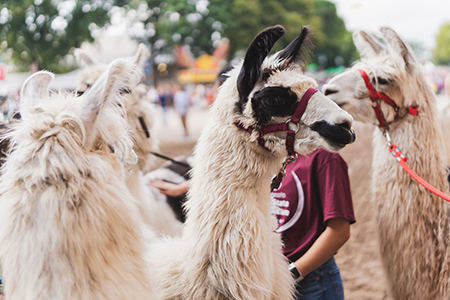
Llama sighting at the Minnesota State Fair.
NAIA note: if you think this newsletter is a little bit shorter than usual, you're not imagining it – that's because it's state fair week for many of us, and we're having a grand old time hanging out with the cows, horses, and other animals. On that note, we sincerely hope you have been able to – or will be able to – get out and enjoy your state fair this year!

Güera, clockwise from upper left: younger days, a very well-trained girl, psammotherapy,
and a freshly cleaned- out screwworm wound that really doesn't do justice to the horror.
Just when we thought we were safe from New World screwworm news, its flesh-eating larvae pop their tiny heads out from places we really didn't want to find them. In this case, a good friend's elderly dog suffered a nasty screwworm infection last week, and it has been a nightmare – and an unfortunate case study in just how labor-intensive and costly it can be to treat a pet that is stricken with this nasty myiasis.
For some background, the dog, Güera (“Blondie”), was found near Cancun, Mexico, 13 years ago, a sweet little stray who was nursing six puppies. Folks in the neighborhood were eager to step up and adopt her puppies (who isn’t?), but after the pups were given homes, poor Güera was forgotten and left to roam the streets once again. Fortunately for her, our friend Miguel* is a real mark – she sized him up, flashed her puppy dog eyes, and followed him home every single day until everyone just assumed she was his dog. After a few weeks of this, he began to cede that maybe she was his dog. With a resigned sigh, he stocked up on kibble, stopped trying to find her a home somewhere else, and officially adopted her himself: mission accomplished!
Recently, a New World screwworm fly (Cochliomyia hominivorax) spotted a scratch near Güera’s scapula, laid some eggs in it, and it has been a harrowing (and incredibly gross) experience for all parties involved. That's putting it mildly. Along with the infected wound and tissue removal, the poor dog – a medium to large mixed breed, probably at least 14 years old – is dealing with daily wound cleaning and inspections, several medications, isolation, and the specter of surgical intervention down the road (it's looking like a coin toss at this point). And to avoid upping your anxiety even more, we won’t go into the veterinary costs (geriatric dogs can be more complicated and expensive to treat). She’s handling it with grace like the grand old dame she is, but it’s been a rough go, and she’s not entirely out of the woods yet.
You know, when we think about screwworm, it’s often in terms of its effect on animal agriculture: the welfare of livestock, food security, and, of course, the economic impact. Those things are huge and meaningful, and they refocus us on issues like biosecurity and the risk of unfettered rescue importation. But as important as the big picture may be, instances like this – where your best friend is endangered and suffering from a painful infection – really do hit a lot harder.
* A pseudonym that raises a question for us: why does it seem like people who are kind to animals in their personal lives so rarely want any sort of recognition for their good deeds?
Source: Continued screwworm threat slows down pet adoptions in Texas
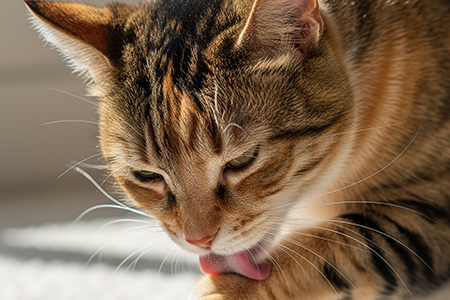
Can you tell this cat is AI-generated?
As with any new applecart-upsetting technology or movement, generative AI is giving humanity a lot of confusion and consternation. It seems like every story we get about AI doing something we like (e.g. revolutionizing cancer treatment) is paired with a dozen stories about students using the tools for cheating and plagiarism, artists, writers, and other creatives being replaced by the machines that were trained on their work, the impact of AI-generated political memes and ads, major environmental concerns, or the fact that the one and only political issue everybody can agree on today is that we don’t want data centers near our homes.
OK, we’ve mentioned AI in medicine, education, the environment, the arts, zoning laws… where do animals factor in? Well, quite a lot of places, actually. After all, animal images and videos are a tried-and-true method of attracting eyeballs and generating clicks. There are tons of people alive today who have never known a world without online cat videos, and the rise of generative AI and deepfake content makes animal videos even more ubiquitous – and misleading – than ever.
Before we cover the harm of fake animal content, it’s important to point out that AI isn’t doing anything we haven’t done before. There are medieval paintings of animals that look completely off the wall because the artists were drawing from third-hand accounts while filling in the blanks with a mixture of best guesses and personal tastes (wonderful art, if highly inaccurate). The 19th century is full of gaff taxidermy – fantasy “deepfake” animals like mermaids, constructed by sewing various real animals together. The advent of film upped the ante: nature documentaries with “enhanced” presentation via props, sound effects, out-of-sequence shots, and other acts of sleight of hand. Disney’s Academy Award-winning White Wilderness features an infamous scene of lemmings being pushed off a cliff (the “suicidal lemmings” myth), while Wild Kingdom boasted curiously perfect animal choreography and was featured in a withering exposé over faked scenes such as staged animal rescues. More recently, PeTA, which has long been accused of faking – or at least exaggerating – videos of animal abuse, received condemnation for a “cat abuse” video where the cat was actually a CGI creation.
So the only thing that is really new here is the technology – and that is precisely the concern. Today, misinformation about animals can be disseminated at a scale and scope that is utterly unprecedented in history. And it is being shared with people who are new to generative AI videos (aren't we all?), and generally speaking, possess very little hands-on animal experience.
There are scams: it’s not that hard to grab a “lost cat” flyer, create a video of said lost cat from the image, then demand money from the frantic pet owner for their cat’s safe return. There are fake wildlife “rescue” videos (like the aforementioned Wild Kingdom – only digital!) that pull viewers in while creating an unrealistic and unsafe perception of wildlife behavior. This also opens the door for animal rights fundraising organizations (like the aforementioned PeTA) to take their ends-justify-the-means attitude and tenuous connection with the truth and simply run hog wild. Even fakes that are seemingly harmless fun (e.g., a bald eagle “massaging” its mate) have an effect on the viewer’s attitude and relationship with animals, which could have downstream consequences for policies related to conservation, animal agriculture, and pet ownership. The implications of this are massive. After all, if we can no longer believe our lying eyes, do we believe nothing – or simply that which we choose?
Source: AI Slop Is Ruining Cute Animals on the Internet
Also in the News...
★ “I was setting up a camera trap when we heard a trumpet. An elephant was charging, flattening every tree in its path. We ran...” (Adventures in Animal Spotting)
★ Child gets into animal exhibit at Milwaukee County Zoo (Zoo Life; Embarrassing, Not Malicious)
★ 36 live, 31 dead animals found in DeWitt Township home (Animal Neglect & Unrelated Arrests; Probable Hoarding; Developing Stories)
★ Exploring the diversity of animal immune systems (Animal Research & Health)
★ Gail Giustino pleads no contest in Martin County's worst animal hoarding case (Animal Neglect & Abuse; Definite Hoarding)
★ Over 2,000 animals spotted off the coast of Cape Cod (Shark Spotting & Aquatic Appreciation)
★ 10 headless animals that can survive without their heads — at least for a while (Headless Goofy Lists; We'll Be Honest: Some of These Are Pretty Gross)
Click here to see what is happening legislatively