

Inside This Issue:
- Return of the Screwworm
- Puppies Seized, Home Condemned
- The Poop on Elephants and Biodiversity
- Two Never-Nevers for Pets and Three Endangered Birds
Return of the Screwworm
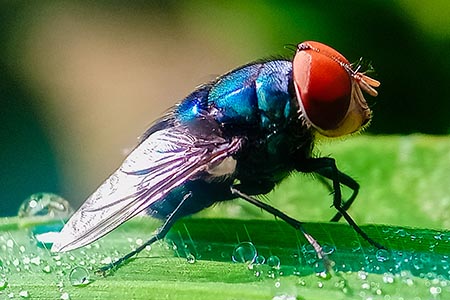
For now, we're only sharing pictures of the fly and not the damage done by its larvae.
New World Screwworm is a parasitic fly with larvae that feed on the living tissue of warm‑blooded animals, causing severe wounds, secondary infections, and even death. It is a major threat to livestock, wildlife, and even people in tropical and subtropical climates. The last severe outbreak in the United States occurred in 1972, and the country has stayed relatively clear since then with strict surveillance, international cooperation, and control measures.
Last year, however, screwworms were detected just south of the U.S. in cattle lots, raising concerns and prompting the USDA to keep a close watch on how livestock was being transported and treated along the southern border. The potential for these flies to decimate the U.S. cattle industry, which is worth billions of dollars, makes early detection and rapid response critical. On June 3rd, the USDA announced that the first case of New World Screwworm had been found in South Texas. This discovery triggered an immediate and coordinated response from federal, state, and local agencies to contain the outbreak. Measures include quarantining affected areas, inspecting livestock, and implementing treatment protocols to stop the spread. Public awareness campaigns are also underway to educate ranchers and the general public on how to identify and report suspected cases. Officials are hopeful that this quick response will curtail the outbreak before it can cause significant damage.
Source: USDA Confirms Presence of New World Screwworm in the United States
Puppies Seized, Home Condemned
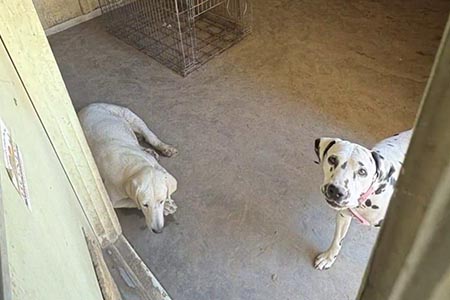
Image from Fox 10 Phoenix social media.
Police raided an Arizona home earlier this week, seizing over 20 dogs and two rabbits. Fifteen of the dogs were Dalmatian puppies, housed in a 105°F plastic bin. After the animals were removed, the house was condemned, as its combination of mess, mold, and extreme heat rendered it “unfit for any life.” In addition, an animal cruelty investigation is being conducted.
Sadly, if you follow animal news with any regularity, this incident isn’t all that shocking. Every week there are breaking stories about animals – especially dogs – seized from terrible conditions. What makes this particular story worth discussing are some of its specific details.
First, this is yet another incident where everybody – or at least the neighbors – knew for years that something shady was going on, and had reported the home “dozens” of times over the years. Now, no reasonable person wants a police state where your neighbor can file a single report and have animal control kicking down your door in 15 minutes. Little things like due process are important, and some neighbors are, frankly, jerks. However, reasonable people can also agree that it shouldn’t take years of complaints to the city before any action is taken. And let’s be clear: oftentimes, that first action can simply be a friendly visit to the pet owner to alert them of the issue, assess the situation, provide tips on animal care, reminders of compliance requirements, etc. – it doesn’t need to be confrontational and threatening, nor should it be. The fact that so many of these “problem homes” fester for years until authorities are left with little choice but to grab all the animals and nuke the property illustrates how these issues are essentially left on the back burner and ignored… until they can’t be.
Another point of interest is how the admin of the police department, when discussing this case with the press, seemingly lamented the fact that animals are “still” viewed as property. This trope feeds into the false perception that, because animals are viewed as property under the law, people are more likely to treat their pets no better than a week-old takeout container. Also, by saying “still,” he suggests frustration with the present and the inevitability of some future promised land where animals are no longer legal property. To be fair, the man is discussing a case of viscerally upsetting, inhumane care, and no doubt means well. His lament is probably how most well-meaning animal lovers feel before examining the issue of animal ownership – and the consequences of abolishing and/or wholesale redefining it – more closely. However, it is important to push back on this idea, even when it comes from a good place.
Finally, there is the issue of breeders as villains. Neighbors called the home a long-time “puppy mill,” while the humane society that took in the seized animals held up this home as an example of why it’s important to eliminate “backyard breeders." Whatever kind of breeding operation this was, we won't get in the weeds trying to find the exact proper term – a bad breeder is a bad breeder, and should not be permitted to operate. However when one bandies about terms like "puppy mill" and "backyard breeder," it is often indicative of a mindset and movement that views dog breeders as greedy and careless (or worse!) until proven otherwise. Incidents like this Arizona home only serve as proofs for their beliefs. Our view is different – more optimistic and pragmatic – and we hope to change the narrative. We feel incidents like this should be used as cautionary examples for prospective dog owners, to show them the vital importance of vetting their breeders... and that breeders, when they see a horrible story like this, are reminded of the need to regularly, and proudly, sharing the wonderful work they do with the world.
Source: Arizona Humane takes in more than 20 dogs from condemned Glendale house
The Poop on Elephants and Biodiversity
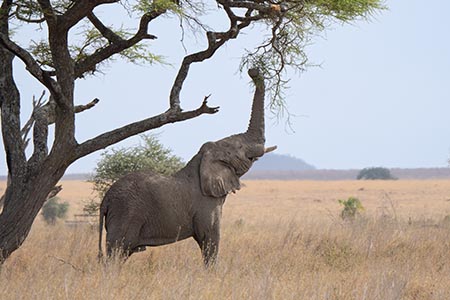
Destroy, create, repeat.
Elephants are more than just the giants of the savanna: they’re what scientists call ecological engineers. Their daily habits have massive effects on the world around them. For example, when elephants knock down trees, they actually help transform dense forests into open, grassy areas. This creates space for a wider range of plants and animals, boosting biodiversity far beyond what would exist without them.
Their impact goes down to the tiniest details. Some frogs only breed in the rain-filled footprints elephants leave behind, turning those puddles into rare, essential habitats. But the story doesn’t stop there: even elephant dung becomes its own ecosystem, providing food and shelter for beetles and other critters.
Recent research has shown, with real-world evidence, just how much entire ecosystems rely on elephants. When elephants are absent, the diversity and abundance of creatures like dung beetles plummet, proving that losing just one species can send shockwaves through the whole environment. Elephants create through destruction: even when eating a whole forest down to the stumps, the seeds get redistributed along the way for a new forest to grow in its place, ensuring their own future and that of all the animals that share their ecosystem.
Source: Elephant Dung Piles are Crucial to Biodiversity, Study Shows
Two Never-Nevers for Pets and Three Endangered Birds

Efforts to save this bird were so intense, it was even provided with drone-delivered sperm for artificial insemination!
After decades of public service announcements about leaving dogs in hot cars, “hot car” dog laws in over 30 states, and numerous Good Samaritan exceptions that allow people to remove dogs from hot cars – even if they have to break a window – you’d probably think that nobody’s dogs would be left unattended in a hot vehicle anymore. Sadly, this is not the case. So with that being the case, here is an annual reminder to the world to make sure our dogs are kept cool this summer, either hanging out in the fresh air or enjoying the indoors with a bit of AC!
Speaking of never-nevers for pets, come on: please don’t leave weed out where your dogs – or other pets – can get ahold of it. Recently, a Bend, Oregon woman reported that her dog got high as a kite after ingesting lord-knows-how-much marijuana from a foil-wrapped pouch he’d come across in the park. The poor dog exhibited classic behavior: dizziness and lack of balance, then vomiting, which prompted an urgent trip to the vet. While it was a frightening incident, the dog bounced back and is right as rain, though the stress probably ate a month or two off the owner’s life. The urgent trip to the vet couldn’t have been cheap, either!
Three endangered birds made the news this week… first, a California condor was spotted in southern Oregon for the first time since Theodore Roosevelt’s presidency. That fits rather nicely, given he was behind the first federal bird sanctuary. Meanwhile, in Japan, backed by a cheering crowd, eight formerly-extinct crested ibises were released into the wild. The birds, which have been officially extinct in Japan since 2003 were brought back with help from China’s captive breeding and conservation program. Finally, now that the almost over-the-top efforts at keeping New Zealand’s kākāpō parrot from going extinct have finally borne fruit, conservationists are hoping to take a step back – but how, exactly, can such a delicious ground-dwelling bird survive in an environment that contains numerous invasive carnivores without round-the-clock monitoring and protection? That’s a tough question!
Also in the News...
★ New S.C. law enhances protections for police animals (Working Animals; Laws Named After Animals)
★ No animals or workers hurt after HVAC unit overheats, fills Elizabethton Animal Shelter with smoke (Rescue & Shelter News; Near Evacuation Avoided)
★ ‘Guilty But Mentally Ill’: Woman takes plea deal in neglect case involving nearly 40 animals (Max Sentence: Hoarding and Abuse, Mental Illness, and Accountability)
★ Is it legal to feed wild animals in Delaware? What the laws say (A Suture Stitch Tapestry of Local Laws; Hurting by Helping)
★ Robot Inspired by Walking Fish Could Reveal How Animals First Moved Onto Land (Roboto Catfish: Jump to the Left; Step to the right)
★ Test Your Animal Habitat Smarts (Check out the Big Brain on Brett)
★ Puffin and bumblebee among 18 creatures shortlisted to feature on banknotes (Lists You Can Vote On!)
Click here to see what is happening legislatively