
Inside This Issue:
- Feral Cat Debate Highlights a Difficult Balancing Act
- Dogs Can Sniff Out Trafficked Wildlife
- (DELTA) Rescue Founder Arrested, Animals and Alcohol, Live Music for Shelter Animals, and More!
Feral Cat Debate Highlights a Difficult Balancing Act
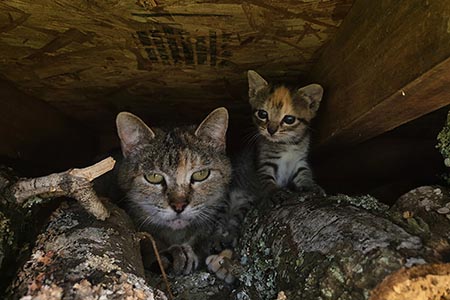
Feral cat and kitten: beautiful animals and an ecological nightmare.
A recent Town Council workshop in Hurley, New Mexico, brought together residents and animal control officers to sort out potential changes to their local animal control ordinance, with a particular focus on how to responsibly address the town’s feral cat problem. The conversation centered on the legal and ethical complexities of the trap, neuter, vaccinate, and return (TNVR) method, a practice widely utilized by animal welfare organizations with the goal of humanely stabilizing and reducing feral cat numbers.
The primary challenge is whether or not the “return” aspect of TNVR, which involves releasing sterilized and vaccinated cats back into their original territory, aligns with New Mexico state law. Some advocates maintain that municipalities have the authority to set their own animal control policies, others are concerned that returning cats to the community could be interpreted as abandonment or cruelty under current statutes. The legalities are unclear and emphasize what many towns face as they attempt to balance animal welfare, public safety, and regulatory compliance.
In the workshop, differing interpretations emerged in regards to municipal authority, the definition of community cats, and the threshold for enforcement action. Town leaders plan to consult further with legal experts to clarify liability and ensure any new rules align with both ethical standards and state requirements. We recognize that managing feral cat colonies is a charged issue for many. While it is natural to want to save cats out of compassion, urban wildlife experts report “the most responsible and humane approach is to remove feral and free-ranging cats from the environment, with euthanasia of unadoptable individuals,” in order to protect native wildlife and public health. Most wildlife departments acknowledge the emotional appeal of TNVR programs, but remind everyone that these efforts are insufficient to counteract the ecological harm caused by feral cats. Our readers are encouraged to approach this topic pragmatically while supporting solutions grounded in best practices and up-to-date scientific understanding that prioritize both animal welfare and environmental sustainability.
Source: Hurley Debates Changes to Animal Control Ordinance
Dogs Can Sniff Out Trafficked Wildlife
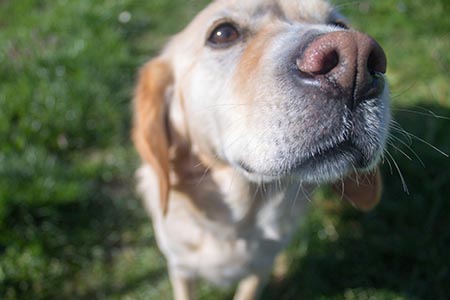
The dog's nose is a marvel.
Wildlife trafficking is a threat to thousands of different species. From charismatic, majestic megafauna like elephants to adorably scaly pangolins (the only mammal with scales and most traficked animal in the world) to unassuming aloe plants, if a species has something – anything, really – that people want, it's not safe. Some trafficking crimes are well-organized and massive in scale. Many, however, are not immediately detected – and given that only an estimated 2% of the world's shipping containers are ever inspected, that’s hardly a surprise.
Not all is gloom and doom however: science and some of the world’s greatest (and cutest) noses are ready and eager to help with enforcement. Researchers have developed a portable extraction device that pulls air samples from inside a shipping container. This air sample is then presented to a specially-trained detection dog that can sniff out the aroma of animals or animal parts. In tests, dogs detected the scent of big cat pelts with a stunning 98% accuracy. This approach also allows the dog to work in an environment of relative peace, safety, and efficiency, since the scent is brought to the animal rather than having it work in a busy port environment.
Purpose-bred dogs, longtime vital partners in law enforcement and search and rescue, may soon become heroes for conservation. While machine-based detectors are being developed, dogs still lead the way, outperforming current technology in both accuracy and reliability. Plus, even if digital technology was comparable, why use a computer when you have the privilege of working with a dog?
Source: Sniffer dogs can detect wildlife trafficking via shipping container air samples
(DELTA) Rescue Founder Arrested, Animals and Alcohol, Live Music for Shelter Animals, and More!

Many Gen Z and younger millennial Cooper hawks have eschewed alcohol for
healthier habits, such as weightlifting.
Leo Grillo, the 77-year-old founder and president of Dedication and Everlasting Love to Animals (DELTA) Rescue was arrested this week for attempted kidnapping. Yes, you read that right. The alleged target was a former employee who won a $6.7 million wrongful termination lawsuit against him in 2024. No word on how this is going to affect Grillo's appeal of the lawsuit, though we can't imagine the arrest being helpful.
We hate that this sounds like the opening to a Seinfeld episode, but what is the deal with people giving animals booze lately? Is a desperate alcohol industry trying to open up untapped markets? Is this just a side-effect of cellphone ubiquity, where the stupid things people have always been doing – things we were blissfully unaware of or refused to believe – are caught on video? Who can say? Nevertheless, while alcohol isn’t exactly healthy for people, we are at least cognizant of its effects and more-or-less capable of processing it. This isn’t something that can be said for wild animals (even if cedar waxwings are famous drunks).
So when a California man captured a federally protected Cooper hawk (highly illegal), then proceeded to pour alcohol down its throat and put a joint in its beak (also illegal), then made the foolish choice of boastfully posting his actions online, it was hardly a surprise he ended up receiving a hefty 45-day sentence, along with numerous other penalties. And given the brazen poor judgment displayed in the videos, it may also be no surprise that when investigators prepared to arrest the man, it turned out he was already in custody, having served 44 of 45 days on charges for other crimes!
In related news, an intoxicated Hempfield man was charged with animal cruelty after walking into a bar with a parakeet in his pocket. We don’t know the local codes regarding parakeets in drinking establishments, but that’s a separate issue. The bird in question was underweight, sick, and had suffered a broken leg. On top of the bird’s unhealthy condition, the man felt it was vitally important for his fellow patrons to know that he gave it marijuana and alcohol every day. The bird was taken to a local vet clinic and treated for its broken leg, and we wish it a full recovery.
A young Arizona mother was mauled to death by three dogs while protecting her 5-year-old son last week. The woman was at her mother’s house to see a litter of puppies. When her son got near the puppies, three adult dogs in the home viciously attacked him. His mother did what she could to protect him, losing her life in the process. Her son was also severely injured and required medical attention, though he was released from the hospital. All three adult dogs were euthanized. We don’t want to rub salt into such a fresh and tragic wound, so we’re not going to conclude this with should-ofs and advice. But there is an investigation ongoing which we are following, and we will definitely quickly revisit the topic (if not this specific case) of children, dogs, and safety.
Speaking of dogs and tragic deaths, a British woman who was scratched by a stray dog in Morocco went home and discovered she had rabies more than four months later. Because the disease is so incredibly rare in the UK (fewer than 30 cases over the last 80 years), it took a psychiatrist inquiring about her travel history before she was properly diagnosed. Sadly, diagnosing the symptoms of rabies couldn’t help her, as the disease is nearly 100% fatal once symptoms have appeared. On a related sidenote, we still strongly oppose the boneheaded importation of foreign street dogs by rescues.
In 2023, 10-year-old Yuvi Agarwal noticed that music had a distinctly calming effect on his dog, and he wondered “Hey, what if we played music for stressed-out shelter animals?” Well, it’s 2026, and he’s now a wizened 12-year-old with a nonprofit called Wild Tunes – and they’re partnering with shelters across six states to put this sweet and clever idea into practice. This week, volunteer musicians aged 16 and up have partnered with the Animal Welfare League of Arlington to ply their trade, while bringing the gift of music and socialization to animals. Now, what were you doing when you were 12?
Also in the News...
★ Webster Parish animal shelter marks one year open, adds new surgery clinic (Rescue & Shelter Milestones; Spay/Neuter Services)
★ Giant salamanders are about to take a once-in-a-year midnight trek (Wildlife Biology & Ethology; 'Phibs' Night Out)
★ (Audio) Wildlife Wednesday: Springtime behaviors of coyotes, foxes and other wild animals (Migration & Sightings; Look What's in the Air! Discussion Starts at 7 Minutes)
★ With Pa. among top in U.S. for animal-vehicle collisions, state looks to develop wildlife corridors (Wildlife & Public Safety; Animal Crossing)
★ Contraceptive vaccine reduces fertility in animals to address wildlife overpopulation (That's One Way to Reduce Animal Crossing)
★ Wild animals in Arizona. 14 species that call the desert home (Lists I: Speaking of Warmer Weather; Snakes, Lizards, and Toads)
★ Meet 8 of the world’s weirdest deadly animals (Lists II: Fun and Deadly; Beware the Cone Snail!)
Click here to see what is happening legislatively